


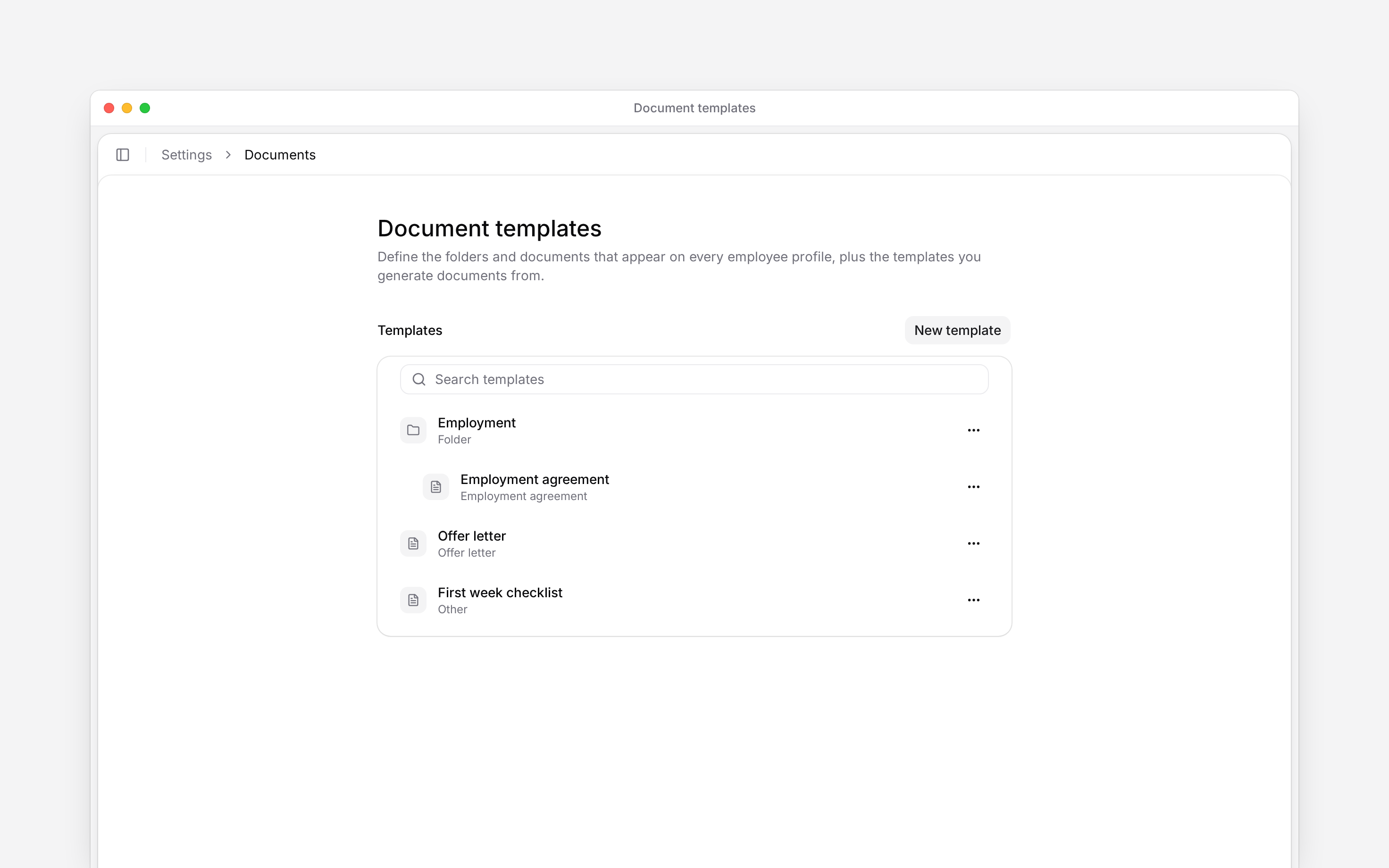
 Use Settings → Document templates to maintain reusable content and folder structures for employee profiles. A template defines the starting content; a person’s generated document is a separate record.
You need permission to manage Document templates settings. By default only administrators have it; a manager needs the Document templates setting added to their role. Being able to upload files or edit people does not grant template-management access.
Use Settings → Document templates to maintain reusable content and folder structures for employee profiles. A template defines the starting content; a person’s generated document is a separate record.
You need permission to manage Document templates settings. By default only administrators have it; a manager needs the Document templates setting added to their role. Being able to upload files or edit people does not grant template-management access.
Create and organise a template
1
Open Settings → Document templates
Choose New template → Add document, or Add folder to organise related templates.
2
Name the template and write its content
Open the document’s editor. In the new-template dialog you can choose Start with example
content, then replace the sample wording with your own.
3
Choose its category
Use a category such as Offer letter, Employment agreement, Policy or Other.
Documents generated from it inherit that category. The category also determines where the
template can be used during onboarding.
4
Finish editing
Content saves as you edit. Use Done to return to the list. Search by template name to find
it again.
Import content and insert variables
In the editor’s … menu, choose Import for a Word.docx or text-based PDF. Content is inserted at the cursor, so place it where you want the imported text. Review the wording and layout afterwards.
PDF imports use Begin AI. If AI is disabled, use a Word document or write the content directly. PDFs must be no larger than 15 MB and 60 pages, and must contain selectable text. Scanned images cannot be imported as text.
Use Insert variable to place a value from the person, employment record or workspace into the template. Recognised placeholders in imported content become variable chips. Check each variable instead of leaving sample names or pay figures in reusable content.
Test the result for a person
Testing also needs permission to read people. If you can edit templates but cannot see Test template, ask your administrator to check that access. Private fields, such as bank details and national IDs, also need View private details for the selected person. Without it, the preview leaves those fields out, including whether they are filled or missing. Choose … → Test template, select an Employee and an Effective date. Check Resolved variables, Missing variables and Body preview. The date matters for employment and pay values that change over time. Missing variables identify where information must be supplied. Update the relevant record and check again. Testing previews the result; it does not generate a document or send anything for signing. A template without variables reports that there are none to test.Review changes or remove a template
Choose … → View history to see who changed the content or details. A history entry with a captured version opens a read-only preview. Older entries without a captured version cannot show that content; viewing history does not restore it. Deleting a folder template also deletes its child templates. Existing employee documents created from those templates are not affected. Check onboarding defaults afterwards if they used a removed template. Editing a template does not rewrite an already generated or signed contract. Make the required change to the person’s document or generate a new one, then follow the signing process for that document.Next
Creating and signing contracts
Generate a document from the template.
Setting up onboarding
Choose templates as hiring defaults.
Still need help?
Contact support
Email the Begin team and we’ll get back to you.
Ask Begin AI
Open the AI assistant and get instant answers based on these docs.