


 A workflow watches for something happening to a time entry and acts on it, with nobody looking at the page. It is how you find out that a shift started twenty minutes ago and nobody clocked in, rather than noticing at the end of the month.
Workflows sits under Manage in the sidebar and carries its own permission. If it is not
there, your role does not have it: ask an administrator rather than looking under Settings.
What can start one
The Time entry triggers cover the life of an entry: created, started, stopped, updated, deleted, approved, rejected, and Time entry status changed for any move between Pending, Needs review, Approved, Rejected and Cancelled. Two more are the ones most workspaces actually want:- Clock-in location outside expected area fires on a clock-in or a clock-out landing outside the allowed location, whatever its name suggests. It is the alerting half of the geofence a clocking policy enforces.
- Shift had no clock-in fires when a rostered shift has started and nobody clocked in. Its Grace period is how long to wait first, and leaving it blank means fifteen minutes.
What it can check, and what it can do
Conditions narrow a trigger that fires too often. Besides the entry’s own status and duration, three are this domain’s own: Location distance check measures how far a punch was from the allowed location, Missing linked shift catches an entry nobody matched to a rostered shift, and Schedule vs actual compares the entry against the shift it is linked to. That last one takes an aspect (Clock-in time, Clock-out time or Paid duration), a comparison (Late, Early, Over or Under) and a tolerance in minutes, so “clocked out more than fifteen minutes over the planned shift” is one block. The actions are Send notification, Request approval, Approve time entry, Reject time entry, Change time entry status, Add label and Remove label. Entry status conditions and Change time entry status include Cancelled. Most useful workflows end in the first two: tell somebody, or put the entry in front of a person who can decide. Add label is how a group of hours becomes its own number in a report, because the report’s label filter finds what the workflow marked. A shift workflow that labels the shift arrives at the same place, since clocking in copies the shift’s labels onto the entry. Build this one first: trigger on Shift had no clock-in with a grace period of ten minutes, filter it to the locations you are responsible for, and end it in Send notification to Reports to, with a fallback for people who have no manager set. Nobody has to watch the schedule to catch a no-show.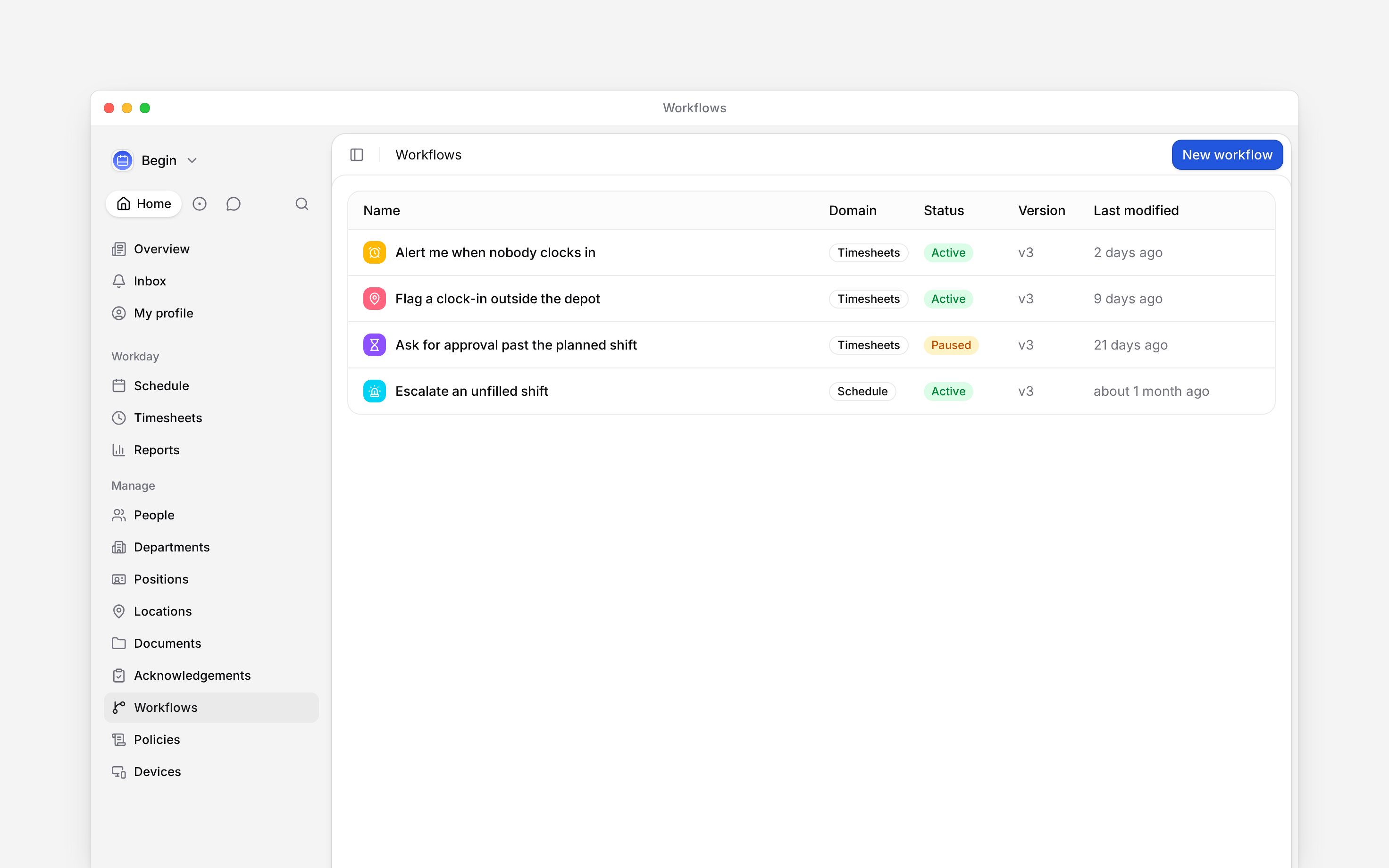
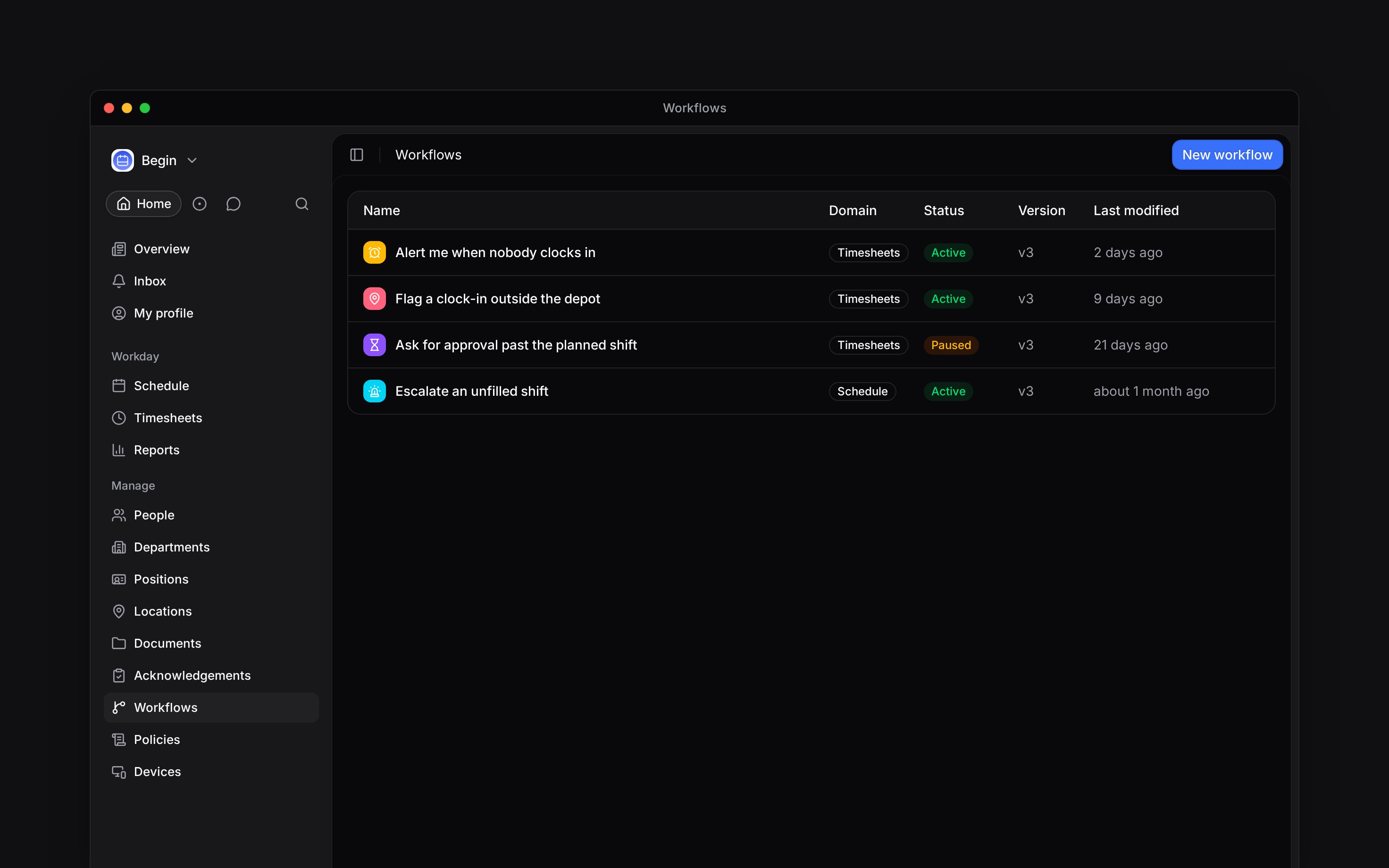
Each workflow carries the domain it watches and whether it is running
A clocking policy set to ask for approval writes its own workflow, and that one’s trigger is
locked to the policy. Edit the rest of it freely; change which entries it fires for on the policy,
not here.
Next
Approving timesheets
What to do with the entries a workflow puts in front of you.
Workflow execution history
Check which version ran and why an action failed.
Still need help?
Contact support
Email the Begin team and we’ll get back to you.
Ask Begin AI
Open the AI assistant and get instant answers based on these docs.