


 If a report total looks wrong, check its period, filters and calculation state first. A list of clock records can include work that a calculated hour total excludes, and a blank or marked cell does not always mean zero hours.
Read the marks
Open Info in the report toolbar and read Help. It distinguishes a measured zero, no measurement, a figure withheld by a rule, and a person whose calculation was refused. On a report of several blocks it also lists which need attention; each row opens that block. Wait for loading hour cells to finish before comparing or exporting them. A calculation still in progress is not a measured zero. Not included lists what a block read but did not count: shifts outside the Status filter, and availability, unavailability and time-off blocks, which a Shifts report never counts. A Shifts report shows how many shifts and hours were not counted, and Open in schedule shows them. On a report of several blocks, open the mark on the block itself.Explain a difference
1
Check the same period and people
Confirm the report’s range, grouping and filters match the records you are comparing.
2
Open the explanation
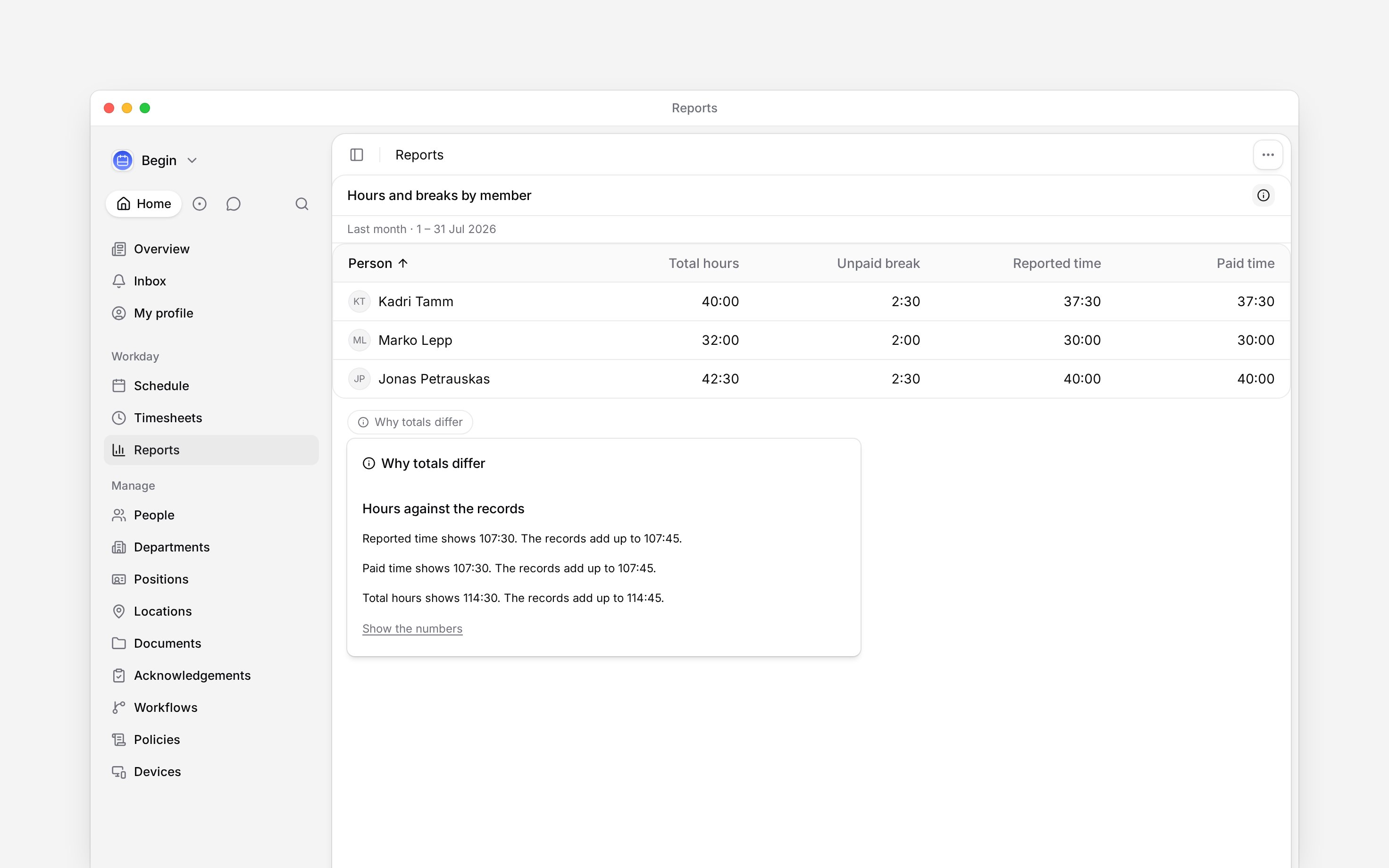
Open the block’s own mark and read Totals; on a report of one block the toolbar’s Info
holds it. Either turns amber when a figure could not be produced, and Needs attention names
that instead.
3
Read the adjustment
Totals names the affected columns and the reason. A reason that applies to every column
reads once below them. Choose Show the numbers for the record total, adjustment and
calculated result.
Calculated time-entry hours count approved work. If the explanation names unapproved entries,
review those entries before using the hours for payroll. A record count and a calculated hour
total can cover different statuses.
Recover an unavailable figure
A permission restriction can also withhold figures that would reveal unpublished shifts. Ask an administrator to check access rather than treating those cells as zero.
A rule can remove whole rows rather than figures. A leave table holding only colleagues you cannot see keeps none of them, and says All rows withheld with the rule in place of its rows. No filter change brings those rows back, so ask an administrator to check access rather than reading the period as empty.
Compare a chart with a table
Charts that sum paid time by person or date use calculated hours too. Counts and break or time-off figures come from records. Other chart groupings may not support the same hour calculation. A chart waits for its whole calculation before it draws anything, because every bar and every metric figure adds people together. While it waits it shows a placeholder instead of a figure, so a chart that has not finished is never a zero. If the calculation stops before it finishes, the block says Still calculating and offers Try again. Read the chart’s notices and Info, then compare the same measure, people, period and filters. A chart’s own menu offers View chart data, which replaces the plot with a table of the same labels and values. Changing the picture from a chart to a table does not, by itself, explain a difference.Next
The hour columns
Check what each hour figure measures.
Reading a day breakdown
Find the days and records behind one person’s total.
Still need help?
Contact support
Email the Begin team and we’ll get back to you.
Ask Begin AI
Open the AI assistant and get instant answers based on these docs.